List of HBCUs: All 107 Schools by State

If you are researching a list of HBCUs, the short answer is that the U.S. Department of Education recognizes 107 Historically Black Colleges and Universities, spread across 19 states, the District of Columbia, and the U.S. Virgin Islands. They range from small private colleges founded before the Civil War to large public research universities, and today they welcome students of every race. Below you will find the full list organized by state, plus the context that makes it easier to read: what qualifies a school as an HBCU, where they cluster, and which ones stand out.
What Makes a College an HBCU
The letters HBCU stand for Historically Black Colleges and Universities. These are schools founded on the belief that every student deserves access to higher education, most of them established when segregation shut Black Americans out of existing institutions. The definition is not informal. The Higher Education Act of 1965, as amended, defines an HBCU as any historically black college or university that was established prior to 1964, whose principal mission was, and is, the education of Black Americans, and that is accredited by a nationally recognized accrediting agency. That accreditation requirement is why the official count is a fixed number rather than an open list, and it is why a school founded to serve Black students after 1964 does not automatically qualify.
How Many HBCUs Are There Today
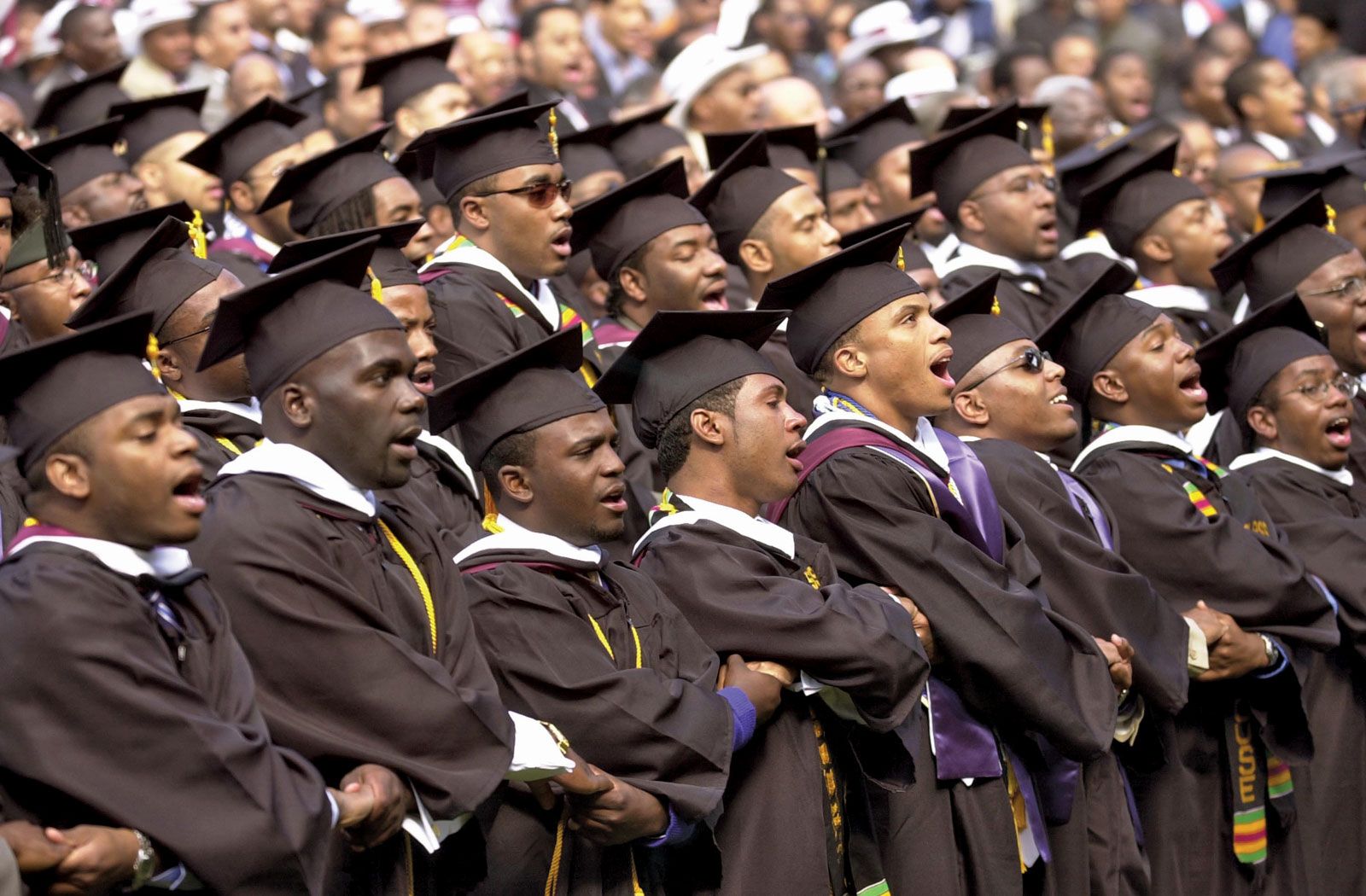
The Department of Education has given the HBCU label to 107 schools, both public and private, and together they enroll more than 228,000 students. The mix is close to even between the two types: of the institutions counted in a recent tally, roughly 52 were public and 49 were private not-for-profit schools. The list is not limited to four-year universities either. It includes two-year public community colleges, several medical schools such as Morehouse School of Medicine and Meharry Medical College, and law schools like the Southern University Law Center. You can confirm the current enrollment figures through the National Center for Education Statistics, which tracks HBCU data year to year.
The Full List of HBCUs by State
Here is the complete list of HBCUs, grouped by state and territory. Each entry notes whether the school is public or private and whether it is a two-year or four-year institution, so you can see at a glance what kind of school it is before you dig deeper.
| State | School | Type | Location |
|---|---|---|---|
| Alabama | Alabama A&M University | Public, 4 Year | Normal, AL |
| Alabama | Alabama State University | Public, 4 Year | Montgomery, AL |
| Alabama | Bishop State Community College | Public, 2 Year | Mobile, AL |
| Alabama | Gadsden State Community College | Public, 2 Year | Gadsden, AL |
| Alabama | H. Councill Trenholm State Community College | Public, 2 Year | Montgomery, AL |
| Alabama | J.F. Drake State Community and Technical College | Public, 2 Year | Huntsville, AL |
| Alabama | Lawson State Community College | Public, 2 Year | Birmingham, AL |
| Alabama | Miles College | Private, 4 Year | Fairfield, AL |
| Alabama | Oakwood University | Private, 4 Year | Huntsville, AL |
| Alabama | Selma University | Private, 4 Year | Selma, AL |
| Alabama | Shelton State Community College | Public, 2 Year | Tuscaloosa, AL |
| Alabama | Stillman College | Private, 4 Year | Tuscaloosa, AL |
| Alabama | Talladega College | Private, 4 Year | Talladega, AL |
| Alabama | Tuskegee University | Private, 4 Year | Tuskegee, AL |
| Arkansas | Arkansas Baptist College | Private, 4 Year | Little Rock, AR |
| Arkansas | Philander Smith University | Private, 4 Year | Little Rock, AR |
| Arkansas | Shorter College | Private, 2 Year | North Little Rock, AR |
| Arkansas | University of Arkansas at Pine Bluff | Public, 4 Year | Pine Bluff, AR |
| California | Charles R. Drew University of Medicine and Science | Private, 4 Year | Los Angeles, CA |
| Delaware | Delaware State University | Public, 4 Year | Dover, DE |
| District of Columbia | Howard University | Private, 4 Year | Washington, DC |
| District of Columbia | University of the District of Columbia | Public, 4 Year | Washington, DC |
| Florida | Bethune-Cookman University | Private, 4 Year | Daytona Beach, FL |
| Florida | Edward Waters University | Private, 4 Year | Jacksonville, FL |
| Florida | Florida A&M University | Public, 4 Year | Tallahassee, FL |
| Florida | Florida Memorial University | Private, 4 Year | Miami Gardens, FL |
| Georgia | Albany State University | Public, 4 Year | Albany, GA |
| Georgia | Clark Atlanta University | Private, 4 Year | Atlanta, GA |
| Georgia | Fort Valley State University | Public, 4 Year | Fort Valley, GA |
| Georgia | Interdenominational Theological Center | Private, 4 Year | Atlanta, GA |
| Georgia | Morehouse College | Private, 4 Year | Atlanta, GA |
| Georgia | Morehouse School of Medicine | Private, 4 Year | Atlanta, GA |
| Georgia | Morris Brown College | Private, 4 Year | Atlanta, GA |
| Georgia | Paine College | Private, 4 Year | Augusta, GA |
| Georgia | Savannah State University | Public, 4 Year | Savannah, GA |
| Georgia | Spelman College | Private, 4 Year | Atlanta, GA |
| Kentucky | Kentucky State University | Public, 4 Year | Frankfort, KY |
| Kentucky | Simmons College of Kentucky | Private, 4 Year | Louisville, KY |
| Louisiana | Dillard University | Private, 4 Year | New Orleans, LA |
| Louisiana | Grambling State University | Public, 4 Year | Grambling, LA |
| Louisiana | Southern University and A&M College | Public, 4 Year | Baton Rouge, LA |
| Louisiana | Southern University at New Orleans | Public, 4 Year | New Orleans, LA |
| Louisiana | Southern University at Shreveport | Public, 2 Year | Shreveport, LA |
| Louisiana | Southern University Law Center | Public, 4 Year | Baton Rouge, LA |
| Louisiana | Xavier University of Louisiana | Private, 4 Year | New Orleans, LA |
| Maryland | Bowie State University | Public, 4 Year | Bowie, MD |
| Maryland | Coppin State University | Public, 4 Year | Baltimore, MD |
| Maryland | Morgan State University | Public, 4 Year | Baltimore, MD |
| Maryland | University of Maryland Eastern Shore | Public, 4 Year | Princess Anne, MD |
| Mississippi | Alcorn State University | Public, 4 Year | Lorman, MS |
| Mississippi | Coahoma Community College | Public, 2 Year | Clarksdale, MS |
| Mississippi | Hinds Community College at Utica | Public, 2 Year | Utica, MS |
| Mississippi | Jackson State University | Public, 4 Year | Jackson, MS |
| Mississippi | Mississippi Valley State University | Public, 4 Year | Itta Bena, MS |
| Mississippi | Rust College | Private, 4 Year | Holly Springs, MS |
| Mississippi | Tougaloo College | Private, 4 Year | Tougaloo, MS |
| Missouri | Harris-Stowe State University | Public, 4 Year | St. Louis, MO |
| Missouri | Lincoln University of Missouri | Public, 4 Year | Jefferson City, MO |
| North Carolina | Barber-Scotia College | Private, 4 Year | Concord, NC |
| North Carolina | Bennett College | Private, 4 Year | Greensboro, NC |
| North Carolina | Elizabeth City State University | Public, 4 Year | Elizabeth City, NC |
| North Carolina | Fayetteville State University | Public, 4 Year | Fayetteville, NC |
| North Carolina | Johnson C. Smith University | Private, 4 Year | Charlotte, NC |
| North Carolina | Livingstone College | Private, 4 Year | Salisbury, NC |
| North Carolina | North Carolina A&T State University | Public, 4 Year | Greensboro, NC |
| North Carolina | North Carolina Central University | Public, 4 Year | Durham, NC |
| North Carolina | Saint Augustine’s University | Private, 4 Year | Raleigh, NC |
| North Carolina | Shaw University | Private, 4 Year | Raleigh, NC |
| North Carolina | Winston-Salem State University | Public, 4 Year | Winston-Salem, NC |
| Ohio | Central State University | Public, 4 Year | Wilberforce, OH |
| Ohio | Payne Theological Seminary | Private, 4 Year | Wilberforce, OH |
| Ohio | Wilberforce University | Private, 4 Year | Wilberforce, OH |
| Oklahoma | Langston University | Public, 4 Year | Langston, OK |
| Pennsylvania | Cheyney University of Pennsylvania | Public, 4 Year | Cheyney, PA |
| Pennsylvania | Lincoln University | Public, 4 Year | Lincoln University, PA |
| South Carolina | Allen University | Private, 4 Year | Columbia, SC |
| South Carolina | Benedict College | Private, 4 Year | Columbia, SC |
| South Carolina | Claflin University | Private, 4 Year | Orangeburg, SC |
| South Carolina | Clinton College | Private, 2 Year | Rock Hill, SC |
| South Carolina | Denmark Technical College | Public, 2 Year | Denmark, SC |
| South Carolina | Morris College | Private, 4 Year | Sumter, SC |
| South Carolina | South Carolina State University | Public, 4 Year | Orangeburg, SC |
| South Carolina | Voorhees University | Private, 4 Year | Denmark, SC |
| Tennessee | American Baptist College | Private, 4 Year | Nashville, TN |
| Tennessee | Fisk University | Private, 4 Year | Nashville, TN |
| Tennessee | Knoxville College | Private, 4 Year | Knoxville, TN |
| Tennessee | Lane College | Private, 4 Year | Jackson, TN |
| Tennessee | LeMoyne-Owen College | Private, 4 Year | Memphis, TN |
| Tennessee | Meharry Medical College | Private, 4 Year | Nashville, TN |
| Tennessee | Tennessee State University | Public, 4 Year | Nashville, TN |
| Texas | Huston-Tillotson University | Private, 4 Year | Austin, TX |
| Texas | Jarvis Christian University | Private, 4 Year | Hawkins, TX |
| Texas | Paul Quinn College | Private, 4 Year | Dallas, TX |
| Texas | Prairie View A&M University | Public, 4 Year | Prairie View, TX |
| Texas | Southwestern Christian College | Private, 4 Year | Terrell, TX |
| Texas | St. Philip’s College | Public, 2 Year | San Antonio, TX |
| Texas | Texas College | Private, 4 Year | Tyler, TX |
| Texas | Texas Southern University | Public, 4 Year | Houston, TX |
| Texas | Wiley University | Private, 4 Year | Marshall, TX |
| Virginia | Hampton University | Private, 4 Year | Hampton, VA |
| Virginia | Norfolk State University | Public, 4 Year | Norfolk, VA |
| Virginia | Virginia State University | Public, 4 Year | Petersburg, VA |
| Virginia | Virginia Union University | Private, 4 Year | Richmond, VA |
| Virginia | Virginia University of Lynchburg | Private, 4 Year | Lynchburg, VA |
| West Virginia | Bluefield State University | Public, 4 Year | Bluefield, WV |
| West Virginia | West Virginia State University | Public, 4 Year | Institute, WV |
| U.S. Virgin Islands | University of the Virgin Islands | Public, 4 Year | St. Thomas and St. Croix, VI |
States With the Most HBCUs
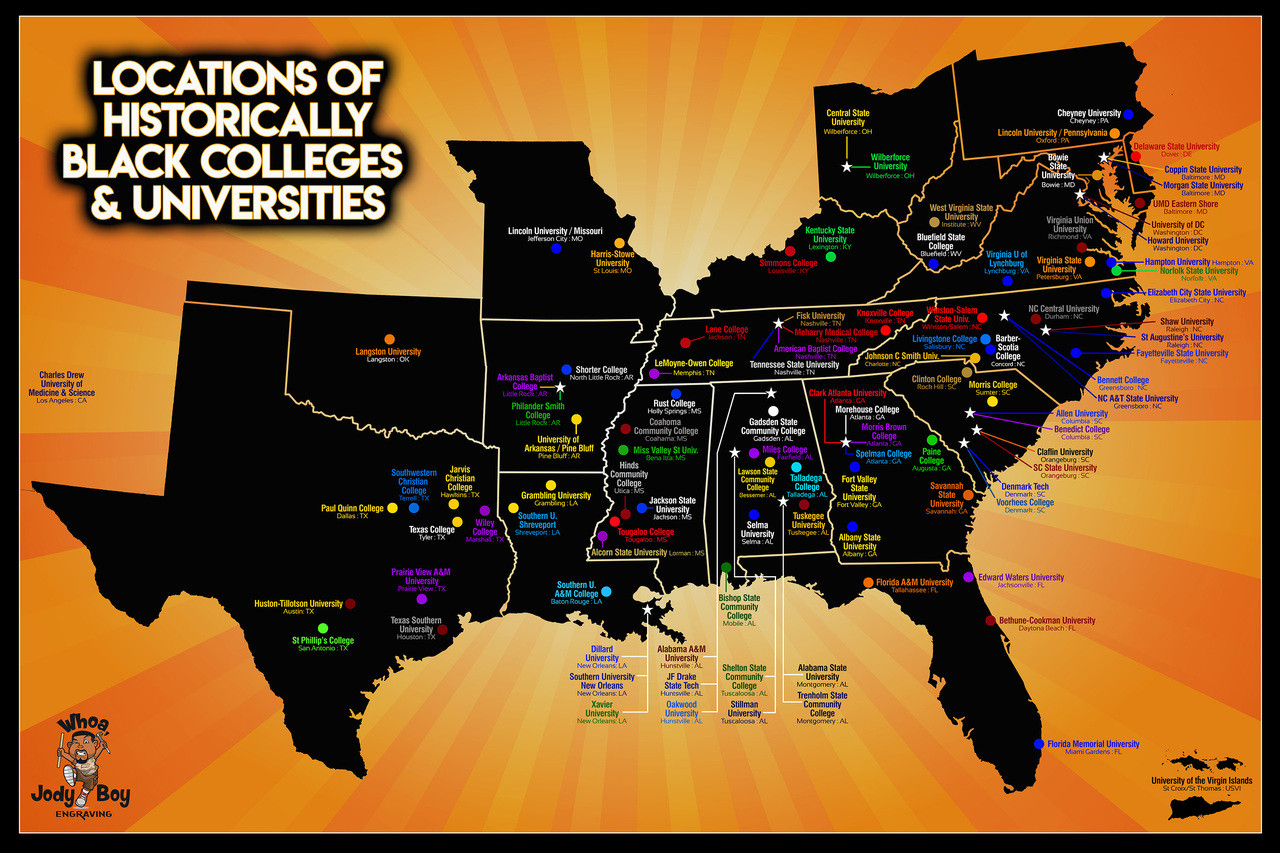
The list is not evenly spread. Far more HBCUs sit in the southeastern United States than anywhere else, a direct reflection of where the Black population was concentrated when these schools were founded. A handful of states carry the bulk of the total:
- Alabama has the most HBCUs of any state, with 14. Nine are four-year universities and five are two-year community colleges.
- North Carolina follows with 12, including some of the oldest schools in the South.
- Georgia is close behind with 10, anchored by the Atlanta cluster of Spelman, Morehouse, and Clark Atlanta.
- Louisiana, Mississippi, and Tennessee each have seven, spread between public and private institutions.
- A few states hold just one HBCU, including California, Delaware, and Oklahoma, and one sits outside the mainland entirely in the U.S. Virgin Islands.
The Black Ivy League
Within the full list, a small group of schools has long carried an outsized reputation for academic prestige and influential alumni. They are informally known as the Black Ivy League, and knowing them helps you read the list with a sense of hierarchy. The original members are:
- Dillard University (New Orleans, LA)
- Fisk University (Nashville, TN)
- Hampton University (Hampton, VA)
- Howard University (Washington, DC)
- Morehouse College (Atlanta, GA)
- Spelman College (Atlanta, GA)
- Tuskegee University (Tuskegee, AL)
Several of these campuses are also known for their vibrant yard culture, where Greek organizations gather and step, and many students weigh the best HBCUs for Greek life alongside pure academic rankings when they choose.
The Largest and Highest-Ranked HBCUs
Prestige and size are not the same thing, and the list separates the two. By enrollment, North Carolina A&T State University in Greensboro is the largest HBCU in the country, followed by Florida A&M University in Tallahassee. Both are public four-year schools with sprawling student bodies. Rankings tell a different story. U.S. News and World Report has named Spelman College, the private women’s liberal arts college in Atlanta, the number one HBCU in the nation, a spot it has held consistently. If you are scanning the list for a starting point, those three names are a reasonable place to begin, though the right fit depends far more on your intended major and the campus you connect with.
Notable Firsts in HBCU History
A few schools on the list carry historical weight that is worth knowing. Cheyney University of Pennsylvania, founded in 1837 by Quaker philanthropist Richard Humphreys as the Institute for Colored Youth, is generally recognized as the first HBCU. Lincoln University, also in Pennsylvania and once known as the Ashmun Institute, was the first HBCU to grant college degrees. Wilberforce University in Ohio, founded in 1856, holds a distinction of its own as the first college owned and operated entirely by African Americans. Shaw University in Raleigh, founded in 1865, is often cited as the oldest HBCU in the South. These founding stories are part of why the list reads less like a directory and more like a record of how Black higher education was built from the ground up.
Choosing From the List
A list of 107 schools can feel like a lot to sort through, but the categories above give you handles to grab. Filter first by state if location matters, then by type if you want a four-year university versus a two-year community college, then by reputation if a marquee name like Howard, Spelman, or North Carolina A&T is what you are after. The Divine Nine Black fraternities and sororities were founded on many of these campuses, so if Greek life is part of the appeal, that history is worth factoring in too. Whichever way you narrow it, every school here shares the same founding purpose, and that shared history is what makes an HBCU degree carry the meaning it does.
Common Questions About HBCUs
What is the number one HBCU in America?
U.S. News and World Report ranks Spelman College, a private women’s liberal arts college in Atlanta, Georgia, as the top HBCU in the nation.
What are the largest HBCUs?
North Carolina A&T State University in Greensboro has the highest enrollment of any HBCU, followed by Florida A&M University in Tallahassee. Both are public four-year universities.
Which state has the most HBCUs?
Alabama leads with 14 HBCUs, followed by North Carolina with 12 and Georgia with 10.
Are HBCUs only for Black students?
No. HBCUs were founded to educate Black Americans when other schools would not admit them, but today they enroll students of every race and background.
How many HBCUs are there in total?
The U.S. Department of Education recognizes 107 Historically Black Colleges and Universities, enrolling more than 228,000 students across 19 states, Washington DC, and the U.S. Virgin Islands.